
In Teachers' Belief and Use of Interactive Whiteboards
for Teaching and Learning authors Yalın
Kılıç Türel and Tristan E. Johnson surveyed teachers in Turkey who
self-reported that they had “actively” used interactive whiteboards (IWBs) in
their classroom(s) for at least six months to determine how they were using IWB
technology, what training they had received, and their perceptions of their
ability to integrate IWB technology into their teachers. 174 teachers who
taught in grades six through twelve months were selected to take a survey which
asked about their use of IWB, what training they had received on this
technology and a utilizing a standard Likert scale were asked to rank from
strong disagree to strongly agree on 26 items related to effectiveness. As
mention in a previous blog post Turkey has embarked on a major initiative to
better integrate information and communication technologies (ICT) into is
public school classroom.
Most of the teachers in the study
had been using IWBs for from 1-3 years (67.8%). They also reported utilizing IWBs
for more that 7 hours per week (61.5%) and with high frequency (frequently
42.5% or always 36.8%). When asked to report their competency with IWB’s in the
classroom the teachers mainly classified themselves as a 3(39.1%) or 4(45.4%)
on a five point scale with 5 being the highest ranking. Based on these responses it seem clear that teachers
felt fairly comfortable with IWB use and many are using them for a fair amount
of instructional time. However another perspective on these finding is that the
vast majority of the teachers surveyed were still fairly new to the technology
(using it for less that three years 93.7%) and almost 38.5 % of teachers used
it for seven or less hours of instructional time per week, in other words, very
little each day.

Survey participates were also
asked to indicate how they used IWB technology and if this use was frequent or seldom.
The most used feature was mouse function (103 out of 174 respondents) and the
lowest use (33 respondents) utilized hyperlinks. There is little discussion in
the article regarding these results. Is the lack of the use of hyperlinks and
the Internet the result of poor connectivity? How could one explain that drag
& drop was only utilized by 78 of the respondents, or drawing by 72? Based on these results it appears that IWB
technology is underutilized and calls into question teachers’ self assessment
of their own competency with IWBs.
A third section addresses how
teachers received training IWB technology. Multiple sources for training were
reported: through vendors (65), their education institution (65), from fellow teachers
(76) and a few were mainly self-taught (26); some received training from
multiple sources. Two thirds of the teachers felt like they had had or did not
need additional training while 1/3 reported that they needed additional
training.Finally, the results from the
Likert scale portion of the study showed strong support for the impact of IWB technology
on managing instructional time, increasing the visual delivery of course material,
improving student learning and teachers felt that learning how to use the IWB
was important to them. Lower marks were found in increasing class discussion
and the ability to include student use of the board in instruction; more than half
of the teachers reported that their instruction had not changed since the
introduction of this new technology. While it is possible that instruction
could improve without changing, for example improved in efficiency, based on the
limited IWB features that teachers are using and their report that instruction
had not changed, it appears that the potential of IWB technology is not being
realized in these classrooms.
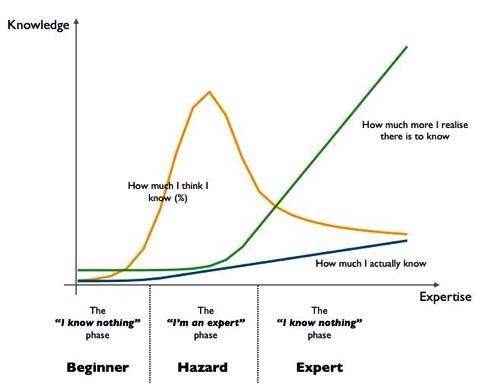
David Dunning is a social
psychologist who has done research into people’s ability to assess their own competence, this effect, the Dunning-Kruger
effect, is named after him and his
colleague Justin Kruger of Cornell University. According to this research people who are inexpert are likely to
overestimate their competence. This concept may apply to teachers in this study
and teacher in general may be more than a little susceptible to this type of
assessment error. Much of our teaching is done in isolation, with little opportunity
to observe, collaborate and/or compare our skills to others in our profession.
And although trends in education are attempting to provide more measurement and
comparison of instructional effectiveness there are so many confounding
variables that most metrics are easily disputable if not inherently flawed. Research
into the use of IWB in classroom instruction is important, but unless this
results in efforts to increase the effective use of technology it is purely academic.
The teachers in this study believe they are doing a good job of integrating IWB
teaching into their teaching, but based on their limited use they are not. Whether
Turkey and other countries are willing and able to provide the professional development
required to support more effective use of their expensive educational technology
initiatives remains to be seen.

No comments:
Post a Comment