Friday, June 26, 2015

Teachers' Perceptions of IWB Use and Effectiveness


In Teachers' Belief and Use of Interactive Whiteboards for Teaching and Learning authors Yalın Kılıç Türel and Tristan E. Johnson surveyed teachers in Turkey who self-reported that they had “actively” used interactive whiteboards (IWBs) in their classroom(s) for at least six months to determine how they were using IWB technology, what training they had received, and their perceptions of their ability to integrate IWB technology into their teachers. 174 teachers who taught in grades six through twelve months were selected to take a survey which asked about their use of IWB, what training they had received on this technology and a utilizing a standard Likert scale were asked to rank from strong disagree to strongly agree on 26 items related to effectiveness. As mention in a previous blog post Turkey has embarked on a major initiative to better integrate information and communication technologies (ICT) into is public school classroom.  


Most of the teachers in the study had been using IWBs for from 1-3 years (67.8%). They also reported utilizing IWBs for more that 7 hours per week (61.5%) and with high frequency (frequently 42.5% or always 36.8%). When asked to report their competency with IWB’s in the classroom the teachers mainly classified themselves as a 3(39.1%) or 4(45.4%) on a five point scale with 5 being the highest ranking.  Based on these responses it seem clear that teachers felt fairly comfortable with IWB use and many are using them for a fair amount of instructional time. However another perspective on these finding is that the vast majority of the teachers surveyed were still fairly new to the technology (using it for less that three years 93.7%) and almost 38.5 % of teachers used it for seven or less hours of instructional time per week, in other words, very little each day.  


Survey participates were also asked to indicate how they used IWB technology and if this use was frequent or seldom. The most used feature was mouse function (103 out of 174 respondents) and the lowest use (33 respondents) utilized hyperlinks. There is little discussion in the article regarding these results. Is the lack of the use of hyperlinks and the Internet the result of poor connectivity? How could one explain that drag & drop was only utilized by 78 of the respondents, or drawing by 72?  Based on these results it appears that IWB technology is underutilized and calls into question teachers’ self assessment of their own competency with IWBs.


A third section addresses how teachers received training IWB technology. Multiple sources for training were reported: through vendors (65), their education institution (65), from fellow teachers (76) and a few were mainly self-taught (26); some received training from multiple sources. Two thirds of the teachers felt like they had had or did not need additional training while 1/3 reported that they needed additional training.Finally, the results from the Likert scale portion of the study showed strong support for the impact of IWB technology on managing instructional time, increasing the visual delivery of course material, improving student learning and teachers felt that learning how to use the IWB was important to them. Lower marks were found in increasing class discussion and the ability to include student use of the board in instruction; more than half of the teachers reported that their instruction had not changed since the introduction of this new technology. While it is possible that instruction could improve without changing, for example improved in efficiency, based on the limited IWB features that teachers are using and their report that instruction had not changed, it appears that the potential of IWB technology is not being realized in these classrooms. 
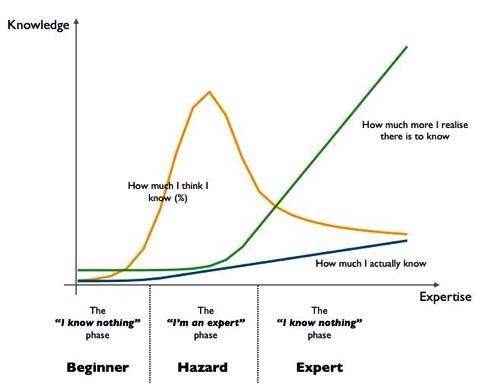

David Dunning is a social psychologist who has done research into people’s ability to assess their own competence, this effect, the Dunning-Kruger effect, is named after him and his colleague Justin Kruger of Cornell University. According to this research people who are inexpert are likely to overestimate their competence. This concept may apply to teachers in this study and teacher in general may be more than a little susceptible to this type of assessment error. Much of our teaching is done in isolation, with little opportunity to observe, collaborate and/or compare our skills to others in our profession. And although trends in education are attempting to provide more measurement and comparison of instructional effectiveness there are so many confounding variables that most metrics are easily disputable if not inherently flawed. Research into the use of IWB in classroom instruction is important, but unless this results in efforts to increase the effective use of technology it is purely academic. The teachers in this study believe they are doing a good job of integrating IWB teaching into their teaching, but based on their limited use they are not. Whether Turkey and other countries are willing and able to provide the professional development required to support more effective use of their expensive educational technology initiatives remains to be seen.

Friday, June 19, 2015

IWBs in Turkey


As teachers it is often too easy to blame students, they don’t study hard enough, aren’t engaged, don’t care about the subject matter, are too interested in boys, girls, partying, etc. But, what happens when we treat students as consumers?  Süleyman Nihat S¸ Ugur Özhan in their article Honeymoon with IWBs: A qualitative insight in primary students’ views on instruction with interactive whiteboard present results of a phenomenological study of student experiences with classroom instruction utilizing interactive whiteboard technology, and the results are pretty interesting.


First some context, Turkey has been involved for about the past five years in a massive initiative named FATIH, to modernize school classrooms; this effort has brought and will continue to bring millions of pieces of technology to schools, including tablet computers and IWB’s. While this mirrors technological initiatives that are occurring worldwide across countries, regions, districts and schools, the scale of Turkey’s program impresses. However, what effect has this influx of technology had? How is it being used? To explore this the authors took an interesting approach, rather than utilizing a big sample size and authoring a questionnaire, they instead selected a representative school in which IWB had been in place for two years and created focus groups of students, who were enrolled in grades four through eight, 10 students per group. 


The researchers met with each group and facilitated discussions based on three broad questions: What do you like the most about having IWBs in your classes?, What do you like the least about having IWBs in your classes?, and (How) does instruction with an IWB enhance your learning? If you have read other research on IWBs you will not be surprised with the findings of this study. But that does not make them less interesting, if anything the student responses are very insightful.


The researchers utilized both inductive and deductive methods to analyze/sort student responses. Students felt that the boards made their teacher's' instruction more effective. Less time was spent writing or drawing on the board, use of the boards also meant that teacher used more video and web based examples, and students reported that this aided their learning, and they noted that when teachers gave tests on the boards that they could see more questions and work more quickly. The overwhelming response to what they disliked about the boards was related to technical problems. This is not very surprising, with any new technology there are going to be glitches; if students like instruction on IWB it is intuitive that when the boards don’t work that they are likely to feel disappointment or frustration. This result does raise questions about how much technical support has been built into Turkey’s ambitious plan to modernize its schools. Finally, the researchers identified one other response cluster, how does use of IWB enhance learning. Student responses indicated that they felt that IWB instruction helped them visualize and contextualize content and that the teachers were overall more effective when using IWBs.

IWB use in Turkey is still fairly new and it is not surprising that many of the instructional techniques that teachers showed a low level of use and integration. The researchers noted that much of what the students liked about the IWBs as an instructional tool could actually be implemented with a laptop and a projector and did not require IWB technology. This is a common problem noted in many research studies across grade levels, regions, etc., and additional teacher training is often seen as a remedy. Whether Turkey addresses this as part of its technology roll-out, which like any large scale project is likely to have hurdles, remains to be seen.


Thursday, June 11, 2015

Whiteboard or Interactive Whiteboard


In their article Transition in pedagogical orchestration using the interactive whiteboard, Gary Beaucamp and Steve Kennewell ask their readers to consider the differences between minimal use of interactive whiteboards(IWB) in the classroom and optimal use of IWDs and their accompanying technologies. On one end of this spectrum is use of the board as an expensive projector and a blackboard/whiteboard. And while they acknowledge that this does not mean that teachers who use this technology in these limited ways cannot be effective. They do suggest that when IWBs are used to their full potential and become central to or a  “hub” for instruction that they can transform a classroom. Teachers who become fluent with use of IWB technology can better orchestrate student learning by making use of different learning modalities and allowing students to have more control over instruction.


In previous articles Beaucamp has suggest thinking about a teacher’s use of IWB technology as progressing through stages. Initially the teacher controls the board, drawing on it, modelling, utilizing it for classroom and lesson organization,  etc. However as the teacher becomes more skilled he/she can expand the use of the board. Later stages are typified by a “classroom culture” which promotes student fluency with and use of the board, use of the board for multimedia, and use of peripheral technology. In the article they compared similar lessons centered on WWII bombings in England, with differing levels of IWB use. Synergistic and highly planned and skilled applications of the IWB resulted in a lesson in which the students received better corrective feedback from both the teacher and their peers as well as, better organization, more flexibility, student directed learning, and the freedom for the teacher to circulate in the classroom and interact more with individual students.


This article can be read as a challenge. As teachers are we more like the teacher whose IWB use created a dynamic student led classroom or honestly are we more like their stage one teacher making minimal use of the technology. It can be easy to justify remaining at a low level of IWB use. How many of us have heard and/or said something like the following: I haven't had enough training; I have some equipment but not all the equipment that I need; I never have gotten used to the latest upgrade; or, if I could count on tech support I would entrust more of my instruction to technology. There is truth in all of these and yet in the end they are really just excuses and rationalizations. Add to this that we rarely see others teach and as a result neither see much good teaching in action nor are we challenged by others. There is often a tendency to think that we are doing great things when really much of what we do is probably rather ordinary at best. Beauchamp and Kennewell do us all a great service by reminding us what good teaching looks like.

Wednesday, June 3, 2015

What Does the Research on IWB Say


Whether made by Promethean, SMART, or Mimio, research on interactive white boards (IWB) shows that they can be effective instructional tools under the right conditions. Before considering this evidence it is important to make a distinction between an instructional medium and an instructional method. Whiteboards are a way to present information, an education medium, and as such they can be a very powerful tool. However, they are not a method of instruction. 

This doesn't mean that they cannot have an effect on student outcomes, but as with any multimedia it is important to consider how the technology can facilitate a particular instructional strategy and not make the mistake of assuming that they are a magical way of making ineffective instruction better. One might speculate that technology could perhaps increase student interest and engagement by making activities more interactive, but we need to determine this with research and temper it with the understanding that technology, unless used with some degree of fluency and skill, may be more likely to inhibit student learning rather that increase it.


So what have researchers found out? Among the many whiteboard-facilitated activities that improve student learning are: annotating, matching, use of pictures, collaborative work, peer instruction, feedback using reveals or student response systems. (O’Bannon, 2015) Additionally, IWB technology can improve classroom management, facilitate multi-modal presentation of learning materials and promote active learning. In 2009, Marzano and Haystead conducted research showing that
three features of IWBs were statistically linked to achievement: student response systems, graphics and videos, and reinforcer properties. 

John Hattie has conducted an extensive meta-analysis of effective teaching practices. Based on his research the following practices have at least a .7 effect size on student achievement:


·      Student self-assessment/self-grading
·      Response to intervention
·      Teacher credibility
·      Providing formative assessments
·      Classroom discussion
·      Teacher clarity
·      Feedback
·      Reciprocal teaching
·      Teacher-student relationships fostered
·      Spaced vs. mass practice


As you see there is significant overlap in what has been shown to be an effect use of IWBs and what is considered effective teaching overall. While not surprising this does lead to some questions for me and other teachers to consider.
  1. Am I incorporating effective teaching techniques with or without use of an IWB?
  2. Could I utilize IWB technology to improve or better facilitate effective teaching?
  3.  Conversely, might use of an IWB be an unnecessary distraction or inhibit effective teaching techniques that I already utilize?
  4. Do I have the necessary technology and skills to utilize IWB in ways that have been demonstrated to be effective and if not how can I obtain these?

Finally, in considering use of IWB I asked my middle school age son how they are typically utilized in his classrooms. He unfortunately confirmed for me that they are mainly expensive projector screens. I specifically asked it he had ever had an activity where he had gotten out of this seat and used the touch screen and he replied "no". When pressed for more information he did remember using a student response system in elementary school and some interactivity with student computers and the board. He attends a suburban middle school in an affluent area which provides laptops for over 1,000 students and attracts highly qualified teachers. It would seem if there were any school that might utilize IWBs effectively that his would be one. While asking a lone rising 8th grader is not at all scientific, it does remind us that providing technology is not enough, training and specific expectations for the use of technology are important too.

Sources:

Blanche OBannon. “Engaging Learners with Interactive Whiteboards.” ETEC Publications, 2015. iBooks. https://itun.es/us/AfSDX.n